


Speculum Humanae Salvationis
The Speculum Humanae Salvationis (Mirror of Human Salvation) is a Christian theological text that aims to show how biblical Old Testament events prefigured episodes in the life of Christ that led to the crucifixion and ultimately to the salvation of humanity. The book uses both text and illustrations to present this theme. The Speculum is not a bestiary or any other kind of moralized animal text; the animals that appear in many illustrations only serve to visually support the main theme.
The original Latin text was written between 1309 and 1324. Its author is unknown with any certainty, though it has been (dubiously) ascribed to various writers, including Ludolph of Saxony, Vincent de Beauvais, Johannes Andreas, and Conrad de Altzheim.
The Speculum is an example of the medieval interest in typology: "a doctrine or theory concerning the relationship of the Old Testament to the New Testament. Events, persons or statements in the Old Testament are seen as types prefiguring or superseded by antitypes, events or aspects of Christ or his revelation described in the New Testament. For example, Jonah may be seen as the type of Christ in that he emerged from the fish's belly and thus appeared to rise from death." (Wikipedia)
Typology is evident in all of the 45 chapters of the Speculum. The story of the dove bringing an olive branch to Noah is said to prefigure the redemption of humanity; the life of Mary (annunciation, nativity, visit of the magi) is compared with various stories from the Old Testament; the rite of baptism, particularly the baptism of Christ, is foreshadowed in the story of Naamen, who bathed in the Jordan River to be cured of leprosy; the temptations of Christ are prefigured by the stories of Daniel overcoming the demon Bel and of David killing a "gluttonous" lion and bear that were killing his sheep; the entry of Christ into Jerusalem is said to be foretold by the triumphant entry into Jerusalem of David after he killed Goliath; the steps leading to the crucifixion are compared to several stories in the Old Testament; and the pattern continues throughout the book. The technique of matching Old Testament stories to New Testament events is the basic theme of the book, and it is a technique that is still used by preachers today.
Manuscripts and Illustrations
There are at least 400 existing manuscripts of the text, produced between the fourteenth and sixteenth centuries. There are translations into French, German, Dutch, Middle English, Czech and Croatian. The Speculum appeared under several titles in its various translations:
- Speculum humanae salvationis (Latin)
- Spieghel der menscheliker behoudenisse (Dutch)
- Spiegel menschlicher Behältnis (German)
- Miroir de la Salvation humaine (French)
- Mirouer de la Redemption (French)
- Miroir du salut (French)
- Miroure of Mans Saluacienne (Middle English)
- Zrcadlo clovecieho spasenie (Czech)
- Zrcalo clovecaskago spasenja (Croatian)
In most manuscripts the illustrations come in pairs, at the top of the two columns of text. In some manuscripts the illustrations are grouped on separate pages following the text, though this is uncommon. The sequence of illustrations is the same in almost all manuscripts, though in some cases the usual scene is not illustrated. The usual pattern for each page is shown below.

The illustrations often show scenes of extreme, bloody violence, which in some manuscripts is depicted very graphically. There is not only the usual war-related violence; there are also scenes of brutal attacks on individuals, sometimes women and children. In some notable cases it is women that are the perpetrators of the violence.
The quality of the illustrations varies between manuscripts, from very fine full paintings to well rendered drawings to rough sketches. Illustrations were sometimes copied directly from other manuscripts; for example, those in Bibliothèque du Château de Chantilly (Musée Condé), Ms 139 are nearly identical to those in Newberry Library, MS 40. Even there is no evidence of direct copying, the illustrators were clearly influenced by the images in other manuscripts.
A sample of the existing manuscripts can be seen under the Manuscripts tab above. More extensive lists can be found in the editions J. Lutz, P. Perdrizet, ed., Speculum Humanae Salvationis (1907) and Edgar Breitenbach, Speculum humanae salvationis: eine typengeschichtliche Untersuchung (1930).
Starting in the late fifteenth century, multiple editions of the Speculum were printed throughout Europe, in most of the languages it was translated into. In keeping with the style of manuscript copies, the printed editions usually had woodcut or engraved illustrations that were clearly based on the manuscript illustrations. The text continued to be popular through the sixteenth century and beyond.
Animal Themes
The animals in the Speculum are not the main theme of the text; they are actually incidental, only included because of their relationship to the stories being told. Unlike in a bestiary, the animals are not described, nor do their attributes serve as a basis for allegory or moralization. In some cases the illustration of an animal is similar to those found in bestiaries and other moralized works (e.g. the elephant with a castle on its back), though the text does not mention any such attributes. The most commonly depicted animal is the lion, which appears in stories about Daniel, Samson, Solomon and David.
In list list below, the extracts from the Speculum are from the Latin edition J. Lutz, P. Perdrizet, ed., Speculum Humanae Salvationis, machine translated to English with corrections. The quotes from the Christian bible are from the New International Version (NIV) or the New Revised Standard Version Updated Edition (NRSVUE) as found on the Bible Gateway web site. Other quote sources are shown after the quote.
Chapter 1: Eve is tempted by a serpent
While the text of the Speculum does not say that the serpent which tempted Eve in the garden of Eden had a woman's head, the illustrations consistently show it. The woman-headed serpent is called the draconcopede. Neither the Christian book of Genesis nor the equivalent book in the Torah describe the serpent as having the head of a woman.
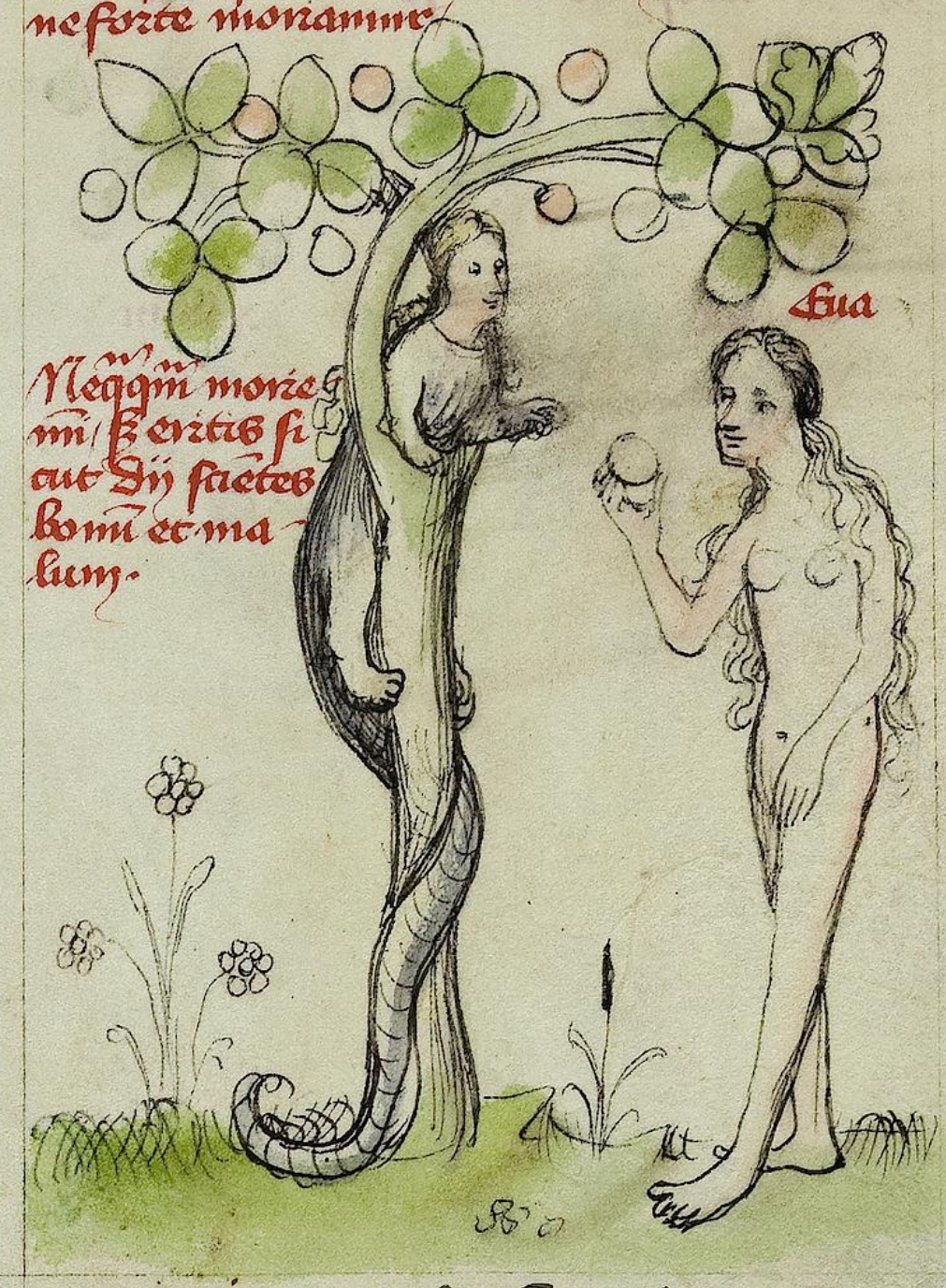
Speculum
- Look at Adam, the work of God's hands and the most powerful Samson,
- Look at David, the man after God's own heart and the wisest Solomon.
- If such men have been deceived by the art of a woman,
- How can you, who are not as them, be safe from a woman?
- The man Adam, whom the devil did not dare to tempt,
- This woman, bolder than the devil, presumed to deceive;
- And so the devil deceived the woman,
- But the woman condemned the man and all his posterity.
- And if man had persevered in the command of God,
- He would never have tasted any punishment, never any death,
- He would have endured no weakness or weariness,
- He would never have felt infirmity or sickness...
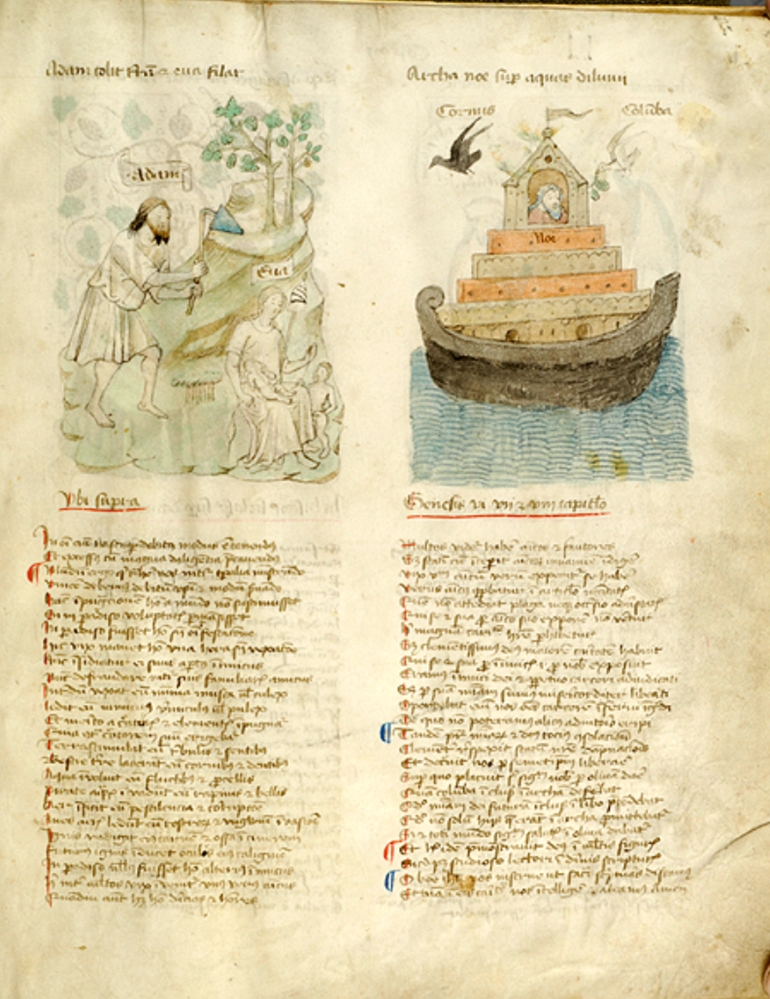
Chapter 2: Noah releases a raven and a dove from the ark
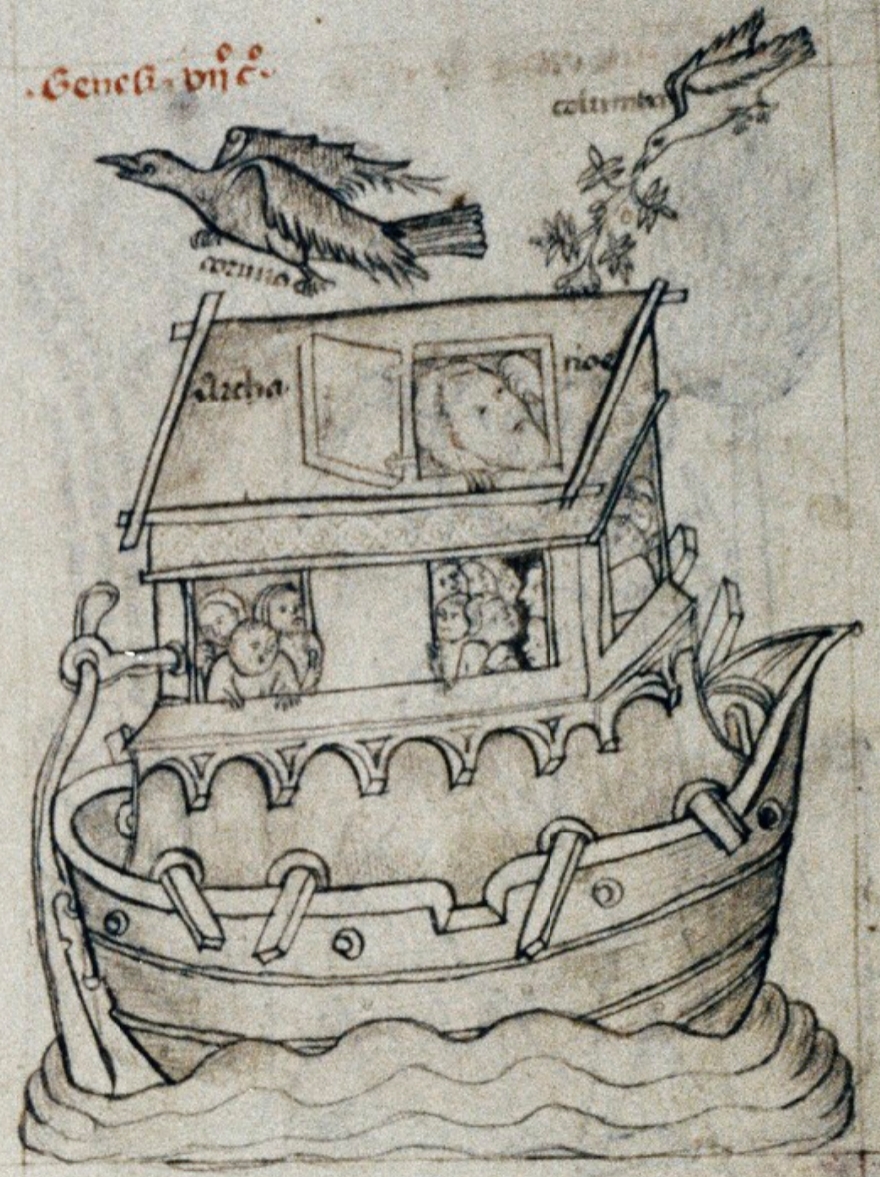
Noah sends two birds to see if the flood has receded. The raven finds no land, but the dove returns with an olive branch which symbolizes God's mercy. In some manuscript illustrations there are several animals on the ark, including quite often a unicorn.
Speculum
- For we were enemies of God and condemned to perpetual imprisonment,
- But by his mercy we are mercifully freed:
- For it was necessary for us all to enter the prison of hell.
- From which we could not be rescued by the help of another.
- Finally the Father of mercies and the God of all comfort
- Mercifully looked upon the state of our condemnation
- And decreed to free us by himself,
- Whereof it pleased him to give us a sign by the olive tree.
- Which the dove carried to the prisoners in the ark,
- Which foretold the future mercy of God to the prisoners in the wilderness,
- Which was promised not only to those who were in the ark,
- But also to the whole world a sign of salvation in the olive tree was given.
Christian Bible, Genesis 8:6-12 (NIV)
After forty days Noah opened a window he had made in the ark and sent out a raven, and it kept flying back and forth until the water had dried up from the earth. Then he sent out a dove to see if the water had receded from the surface of the ground. But the dove could find nowhere to perch because there was water over all the surface of the earth; so it returned to Noah in the ark. He reached out his hand and took the dove and brought it back to himself in the ark. He waited seven more days and again sent out the dove from the ark. When the dove returned to him in the evening, there in its beak was a freshly plucked olive leaf! Then Noah knew that the water had receded from the earth. He waited seven more days and sent the dove out again, but this time it did not return to him.
Chapter 9: Lions surround the throne of king Solomon
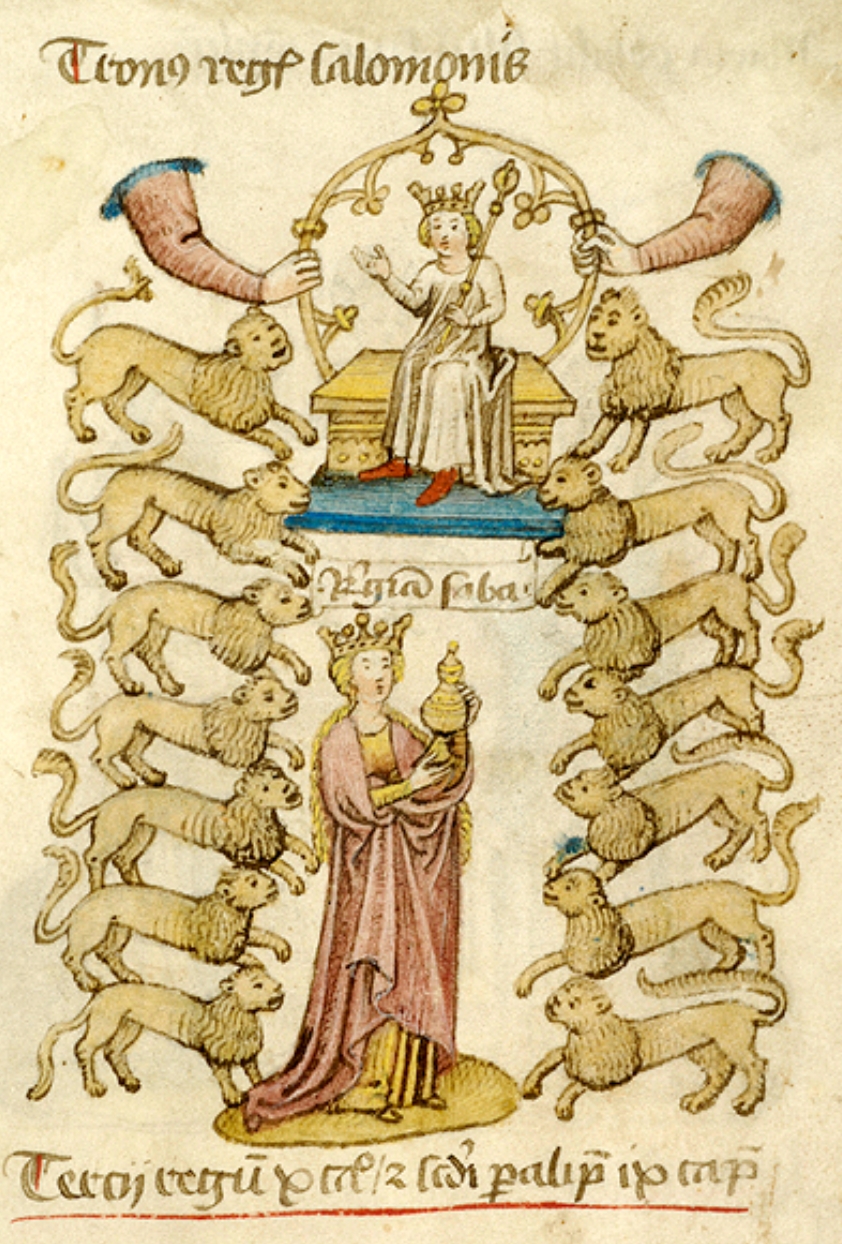
King Solomon sits on a throne, with lions beside him and more lions below on the steps. The 12 lions are symbolic of the attributes of Mary. Many manuscript illustrations do not accurately follow the text, showing fewer lions, or (as here) no steps below the throne.
Speculum
- The throne of the true Solomon is the Blessed Virgin Mary,
- In which Jesus Christ, the true Sophia, resided.
- This throne was made of the noblest treasure,
- Of white ivory, namely, and exceedingly tawny gold.
- Ivory, because of its whiteness and coolness
- Designates virginal purity and chastity.
- Ancient ivory takes on a red color
- Thus ancient and long chastity is considered martyrdom.
- Gold, because it surpasses all metals in its value,
- Signifies charity, which is the mother of all virtues.
- Mary, therefore, is called ivory because of her virginal chastity
- And clothed in gold because of her most perfect charity.
- ...
- Solomon's throne was exalted above six steps,
- And Mary excels the six states of the blessed:
- For she excels the state of the patriarchs, prophets and apostles,
- Also the state of martyrs, confessors and virgins.
- Or Solomon's throne had six steps,
- Because Mary was born after six ages of the world.
- Twelve little lions adorned the throne above six steps,
- Because the twelve apostles ministered to Mary as the queen of heaven.
- Or twelve little lions adorned the throne,
- Because the twelve patriarchs were Mary's progenitors.
- The throne had two larger lions,
- Because Mary held the two tables of commandments with her heart and strength.
Christian Bible, 1 Kings 10:18-21 (NIV)
Then the king made a great throne covered with ivory and overlaid with fine gold. The throne had six steps, and its back had a rounded top. On both sides of the seat were armrests, with a lion standing beside each of them. Twelve lions stood on the six steps, one at either end of each step. Nothing like it had ever been made for any other kingdom. All King Solomon’s goblets were gold, and all the household articles in the Palace of the Forest of Lebanon were pure gold. Nothing was made of silver, because silver was considered of little value in Solomon’s days.
Chapter 13a: Daniel kills a dragon without using weapons
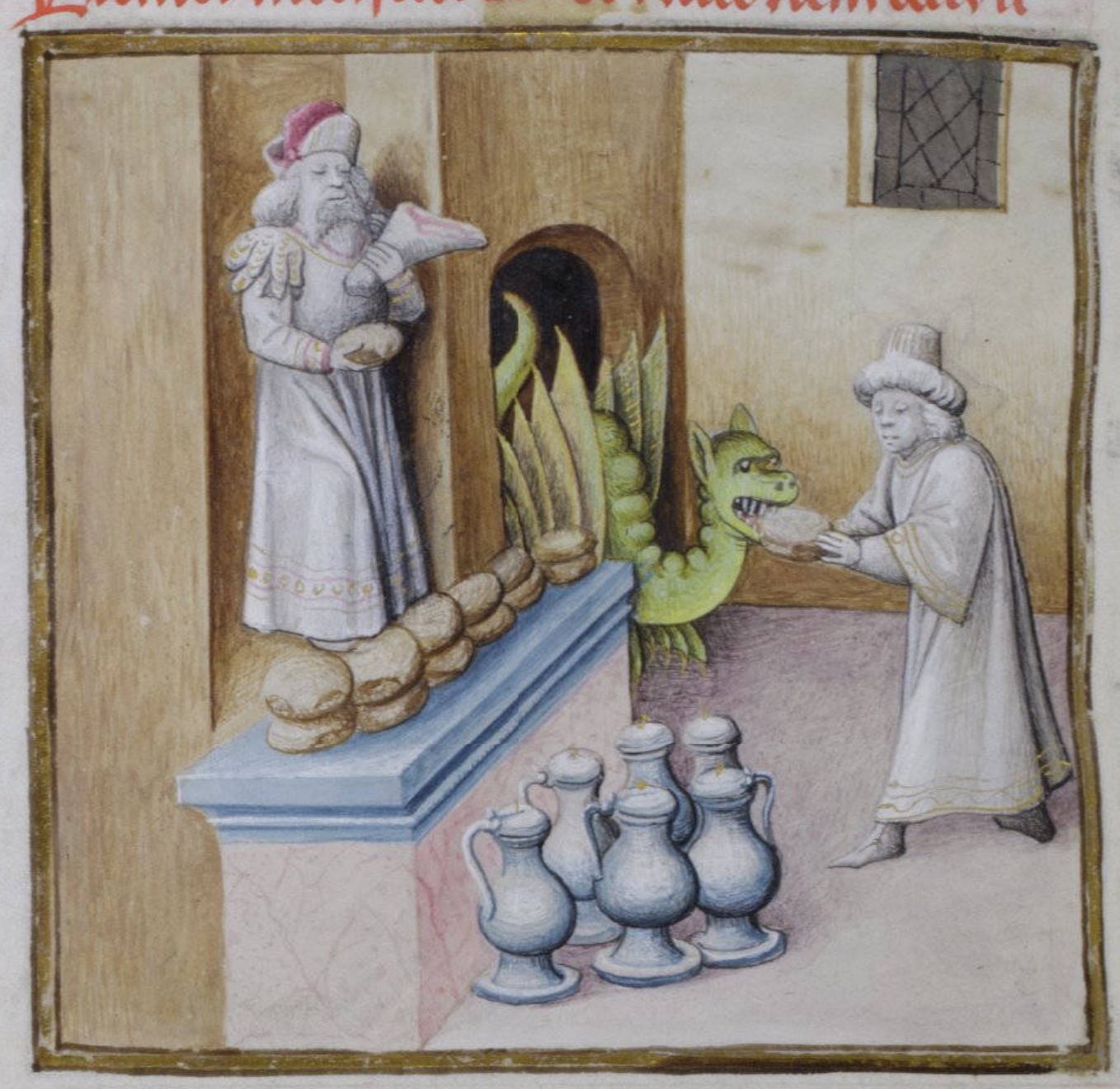
In the story of the Daniel defeating the demon Bel and the dragon of the Babylonians, Daniel first reveals Bel to be a fraud, then kills the dragon by feeding it until it bursts, showing that it was no god.
Speculum
- There also a certain dragon hid in a cave,
- Which the whole nation esteemed as a god
- And at appointed hours his priest offered him his food,
- Which he gratefully accepted, and always remained there.
- But Daniel made a paste of pitch and fat and hair,
- And with the king's permission he threw it into the dragon's mouth.
- Which when he had eaten, he immediately burst,
- And both devourers were destroyed by Daniel.
- So Daniel, who annihilated these devourers and gluttons,
- Prefigured Christ, who overcame the temptation of gluttony.
Christian Bible, Daniel 14:23-27 (NRSVUE)
Now in that place there was a great dragon that the Babylonians revered. The king said to Daniel, “You cannot deny that this is a living god, so worship him.” Daniel said, “I worship the Lord my God, for he is a living God. But give me permission, O king, and I will kill the dragon without sword or club.” The king said, “I give you permission.” Then Daniel took pitch, fat, and hair and boiled them together and made cakes, which he fed to the dragon. The dragon ate them and burst open. Then Daniel said, “See what you have been worshiping!”
Chapter 13b: David kills a bear and a lion
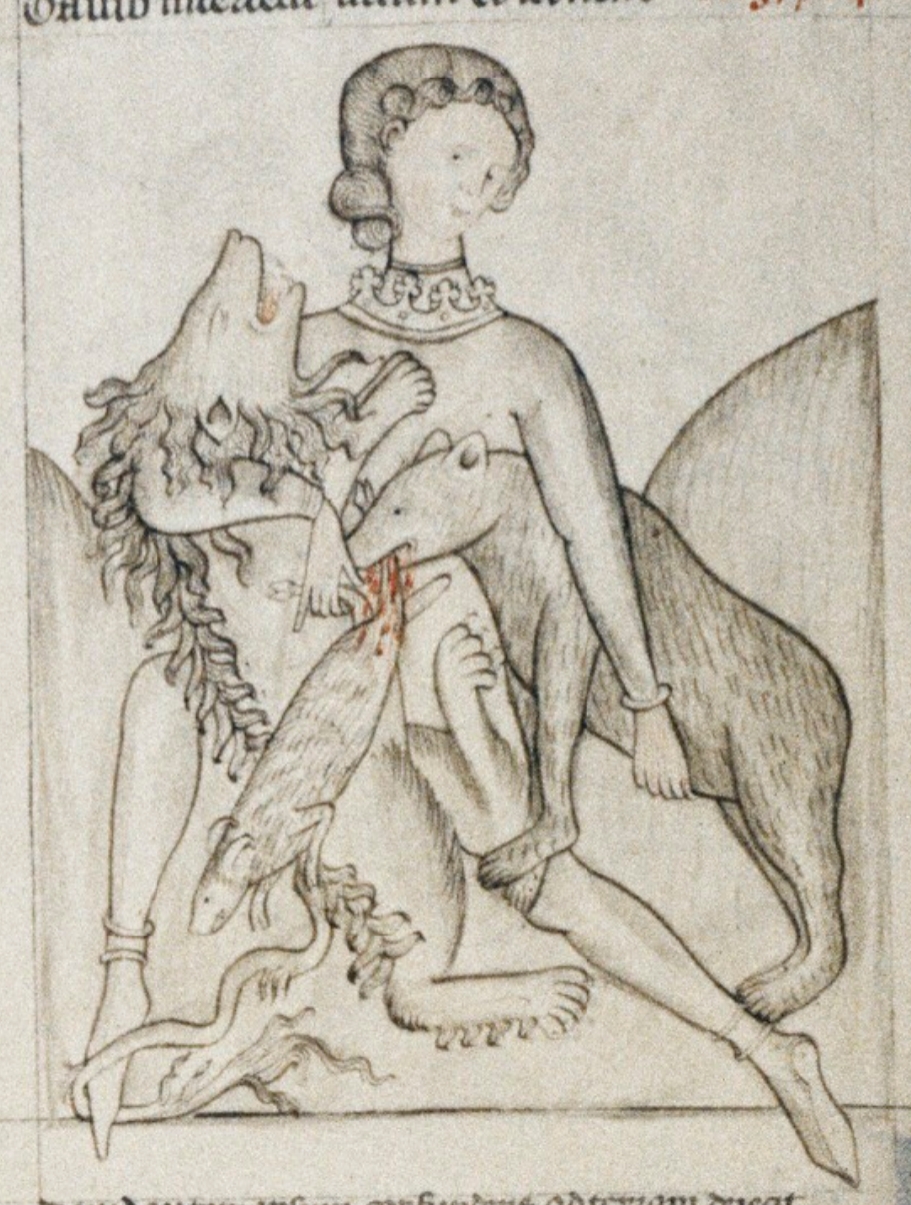
David killed both a bear and a lion to protect his flock of sheep. The bear and the lion are said to be symbols of greed or gluttony.
Speculum
- Christ overcame the devil in the temptation of greed
- This was also foreshadowed by David in the killing of the lion and the bear.
- The lion and the bear fittingly symbolized greed,
- For by taking away his sheep, they committed robbery.
- But David, rescuing his sheep, killed the robbers,
- And Christ, having overcome the temptation of greed, cast Satan from him.
Christian Bible, 1 Samuel 17:34-36 (NIV)
But David said to Saul, "Your servant has been keeping his father’s sheep. When a lion or a bear came and carried off a sheep from the flock, I went after it, struck it and rescued the sheep from its mouth. When it turned on me, I seized it by its hair, struck it and killed it. Your servant has killed both the lion and the bear; this uncircumcised Philistine will be like one of them, because he has defied the armies of the living God. The Lord who rescued me from the paw of the lion and the paw of the bear will rescue me from the hand of this Philistine."
Chapter 24a: Nebuchadnezzar dreams of a tree sheltering many animals
The illustrations for this story sometimes show several birds in the tree and several animals on the ground, though some only show a few generic birds. The unicorn and the ape are featured in several illustrations, as is the pelican reviving her chicks.
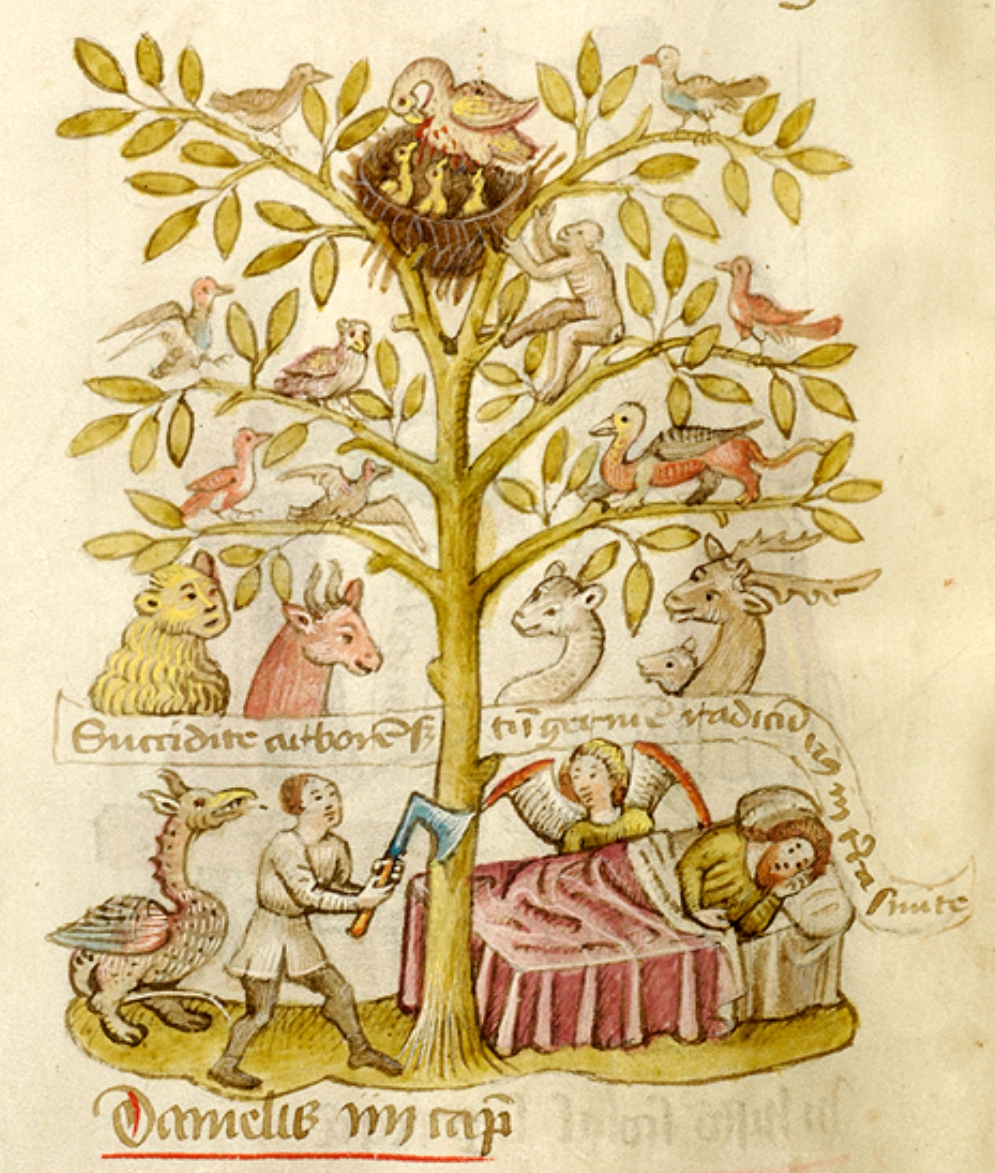
Speculum
- King Nebuchadnezzar saw in a dream a great tree,
- Which, stretching itself into heaven, spread its branches throughout the world;
- This tree signified King Nebuchadnezzar himself,
- But mystically it foreshadowed Christ, who would be king in the world.
- Whose power is exalted above all the heavens
- And extends throughout the whole world above all the powers of the world.
- All the beasts and birds dwelt in it,
- And all ate and were nourished by its fruits.
- By this it was quite fittingly indicated,
- That all creation is sustained by the grace of Christ.
- And behold, an angel coming, commanded the tree to be cut down.
- By which it was signified that Christ should be crucified,
- And he said that all its branches should be cut off,
- Indicating that all the apostles should be separated from Christ;
- He also added that all the leaves of the tree should be shaken off,
- Indicating that all the evidences of Christ should be despised by the Jews;
- He added further that all the fruits of the tree should be scattered,
- Indicating that all the works of Christ should be despised by the Jews;
- He also said that all beasts and birds should flee from it,
- Because neither men nor angels would help Christ.
Christian Bible, Daniel 4:10-15 (NIV)
These are the visions I saw while lying in bed: I looked, and there before me stood a tree in the middle of the land. Its height was enormous. The tree grew large and strong and its top touched the sky; it was visible to the ends of the earth. Its leaves were beautiful, its fruit abundant, and on it was food for all. Under it the wild animals found shelter, and the birds lived in its branches; from it every creature was fed. In the visions I saw while lying in bed, I looked, and there before me was a holy one, a messenger, coming down from heaven. He called in a loud voice: ‘Cut down the tree and trim off its branches; strip off its leaves and scatter its fruit. Let the animals flee from under it and the birds from its branches. But let the stump and its roots, bound with iron and bronze, remain in the ground, in the grass of the field.
Chapter 24b: Eleazar Avaran and the elephant
The elephant with a castle on its back is commonly illustrated in bestiary, Physiologus, and encyclopedia manuscripts. The Speculum text only says it is a war elephant and does not mention the castle.
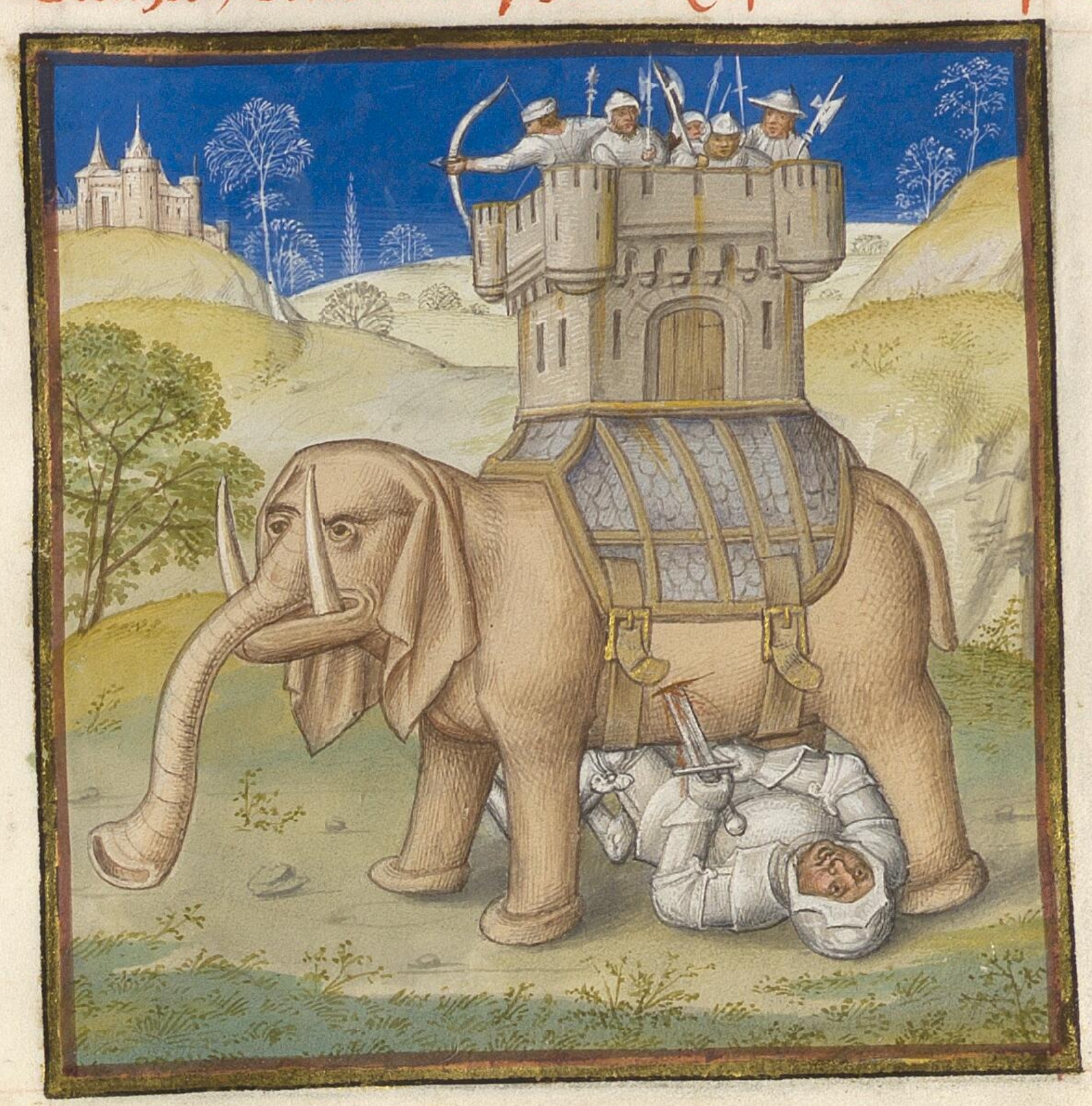
Speculum
- Christ so loved us that He gave Himself to death willingly,
- That He might free us from the siege of demons;
- He clothed Himself with human flesh as with the garment of a servant,
- For in royal apparel, that is, in divinity, He could not be killed.
- If they had also known that He was the King of glory,
- They would never have deceived Him nor killed Him.
- And not only did Christ disperse the siege of our captivity,
- But by His death He also destroyed and killed our death.
- And this was once foreshadowed by Eleazar Maccabee,
- Who exposed himself to death, that he might slay an elephant in armor.
- For when the army of the Gentiles fought against the children of Israel,
- Eleazar, attacking, pierced their elephant with a spear,
- Who, wounded with a deadly wound, fell.
- And falling upon his slayer, he crushed him:
- The strong man thrust into the strong, and they both fell;
- So Eleazar against the elephant, and both died.
- Thus Christ, strong, conquered strong death
- And through his death he mortified our death.
Christian Bible, 1 Maccabees 6:43-46 (NRSVUE)
Now Eleazar, called Avaran, saw that one of the animals was equipped with royal armor. It was taller than all the others, and he supposed that the king was on it. So he gave his life to save his people and to win for himself an everlasting name. He courageously ran into the midst of the phalanx to reach it; he killed men right and left, and they parted before him on both sides. He got under the elephant, stabbed it from beneath, and killed it, but it fell to the ground upon him and he died.
Chapter 25: Evilmerodach cuts up his father's corpse and feeds it to 300 vultures
This story is part of Jewish historical mythology, found in the Chronicles of Jerahmeel, an anthology of Hebrew texts compiled in the fourtenth century. "Evilmerodach" is sometimes written as "Evil Merodach". The birds that eat the the pieces of the corpse are usually called vultures, but the illustrations depict a variety of birds.
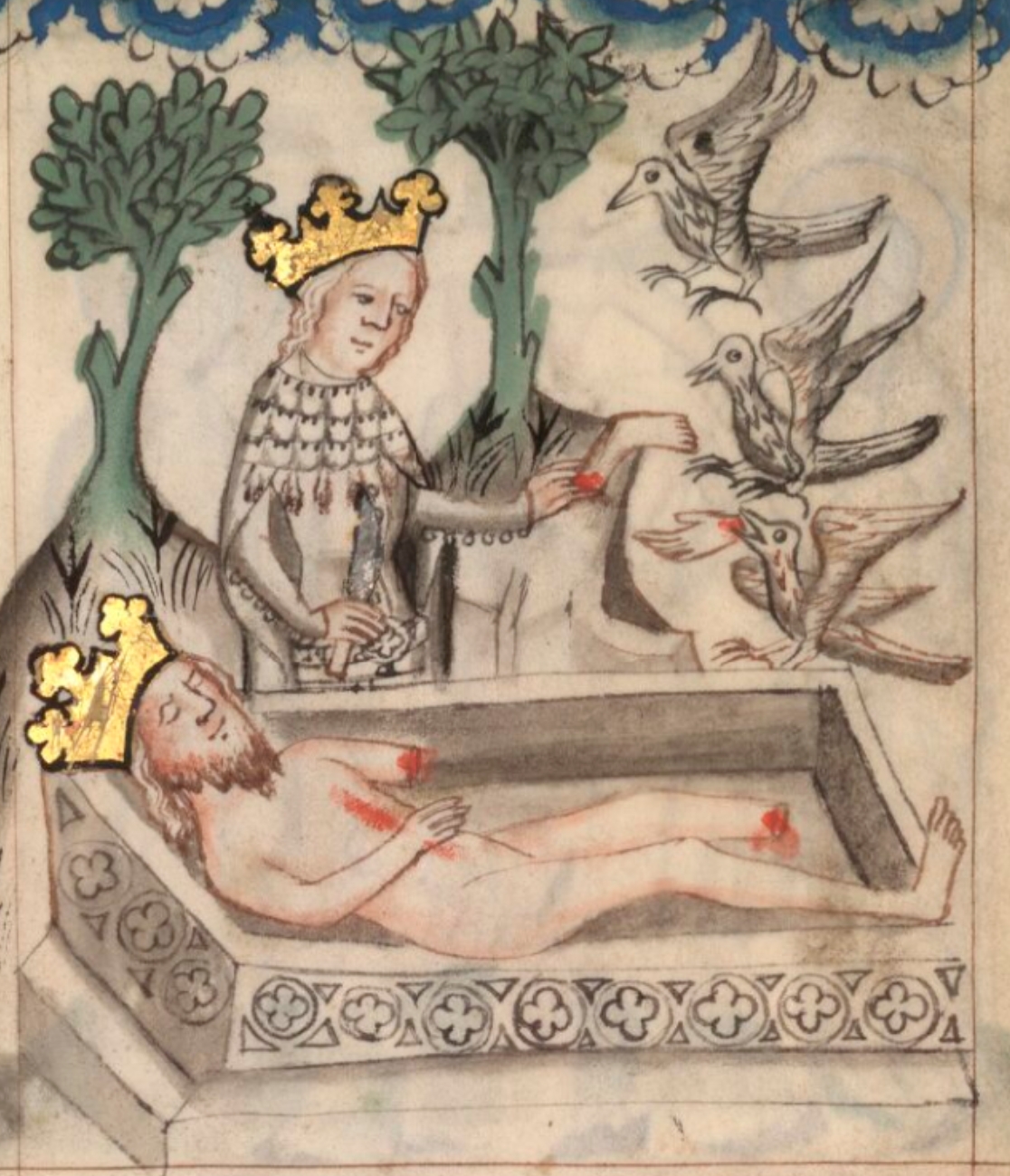
Speculum
- In this way all voluntary sinners attack Christ,
- Who by sinning voluntarily, repeatedly crucify him.
- These were once foreshadowed by King Evilmerodach,
- Who had raged against his dead and buried father;
- He divided his father's body, dug out of the tomb, into three hundred parts
- And distributed it to three hundred vultures to devour;
- So evil Christians rage against their Father Christ, who died for them,
- When by sinning voluntarily, repeatedly crucify him
- They sin more who offend Christ reigning in divinity,
- Than who crucified him living in humanity.
The Chronicles of Jerahmeel
[LXVI.5] Now, in the thirty-seventh year of the captivity of Jehoiachin, King of Judah, on the twenty-seventh day of the twelfth month, Evil Merodach, King of Babylon, in the first year of his reign, rescued Jehoiachin, King of Judah, from prison, and raised his throne above that of any other king in Babylon, and, changing his prison garments, he maintained him as long as he lived. He did this because Nebuchadnezzar the Great did not keep his faith with him, for Evil Merodach was really his eldest son; but he made Nebuchadnezzar the Younger king, because he had humbled the wicked. They slandered him to his father, who placed him (Evil Merodach) in prison together with Jehoiachin, where they remained together until the death of Nebuchadnezzar, his brother, after whom he reigned.
[LXVI.6] "I fear my father Nebuchadnezzar," he said, "lest he rise from his grave, for just as he was changed back from an animal to a man, so in the same manner he may rise up from death to life." But Jehoiachin advised him to take the corpse out of the grave, and, cutting it into 300 pieces, to give it to 300 vultures, and he said to him, "Thy father will not rise up until these vultures have brought back the flesh of thy father, which they have eaten." - [From The Chronicles of Jerahmeel (page 206-207)]
Chapter 27: Jonah is swallowed by a whale
Though the original story in the Christian bible says Jonah was swallowed by a "great fish", medieval writers commonly refrerred to it as a whale. As with most whale illustrations, the "whale" is usually depicted as a large, scaled, toothy fish.
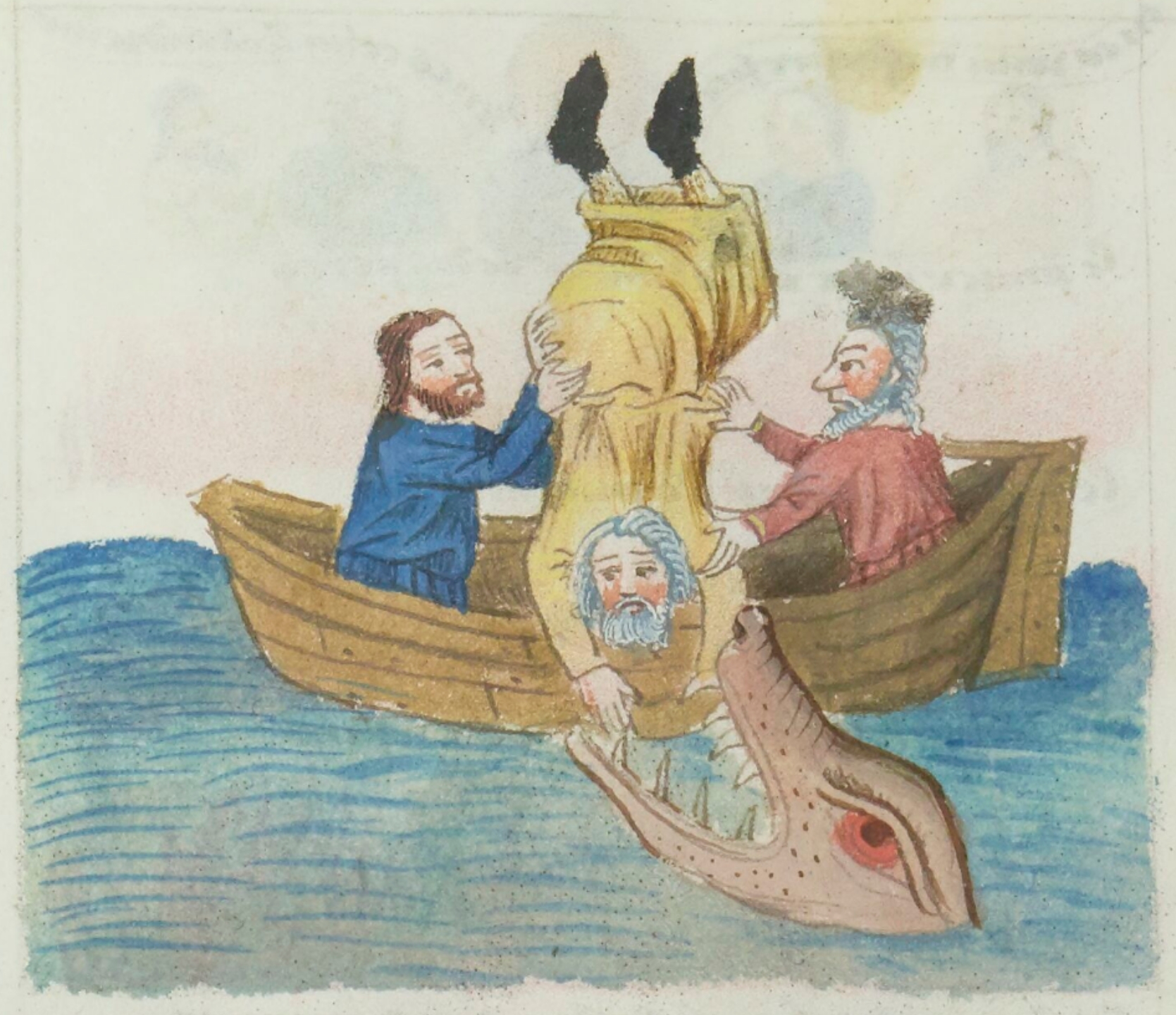
Speculum
- The burial of Christ was also foreshadowed by Jonah,
- Who, thrown from the ship into the sea, was swallowed by a whale.
- Jonah was in the whale for three days and nights;
- So Christ was in the tomb for three days.
- But how the story of Jonah is appropriated to the Savior.
- It is made manifest in the chapter on the resurrection.
- O good Jesus, grant us to venerate your burial so,
- That we may never deserve to be separated from you forever!
Christian Bible, Jonah 1:-11-17 (NIV)
The sea was getting rougher and rougher. So they asked him, "What should we do to you to make the sea calm down for us?" "Pick me up and throw me into the sea," he replied, "and it will become calm. I know that it is my fault that this great storm has come upon you." Instead, the men did their best to row back to land. But they could not, for the sea grew even wilder than before. Then they cried out to the Lord, "Please, Lord, do not let us die for taking this man’s life. Do not hold us accountable for killing an innocent man, for you, Lord, have done as you pleased." Then they took Jonah and threw him overboard, and the raging sea grew calm. At this the men greatly feared the Lord, and they offered a sacrifice to the Lord and made vows to him. Now the Lord provided a huge fish to swallow Jonah, and Jonah was in the belly of the fish three days and three nights.
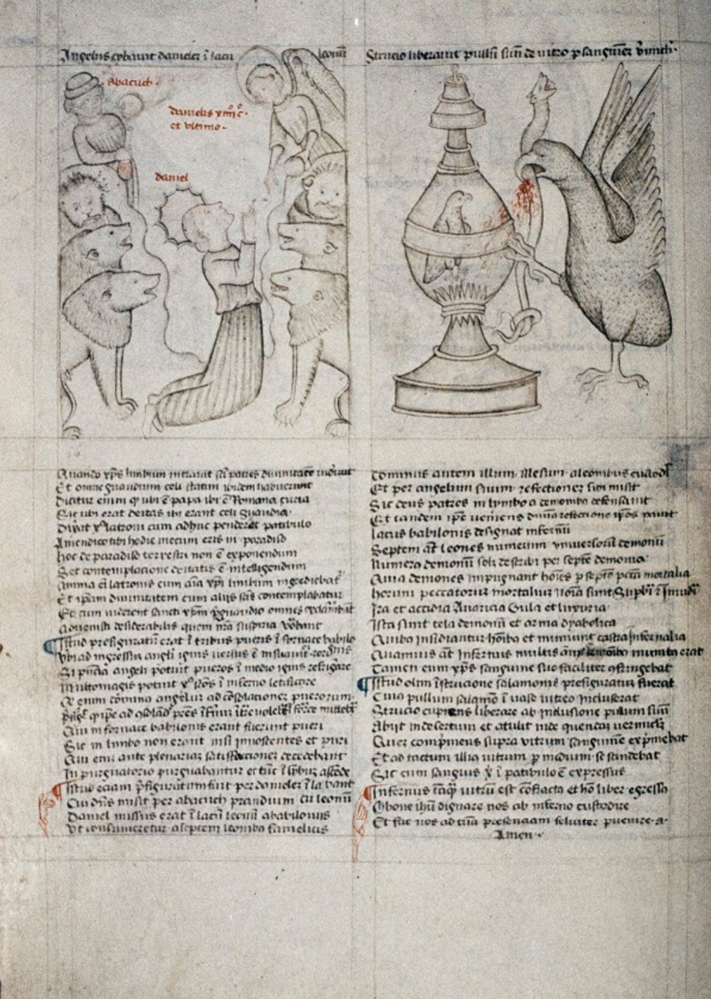
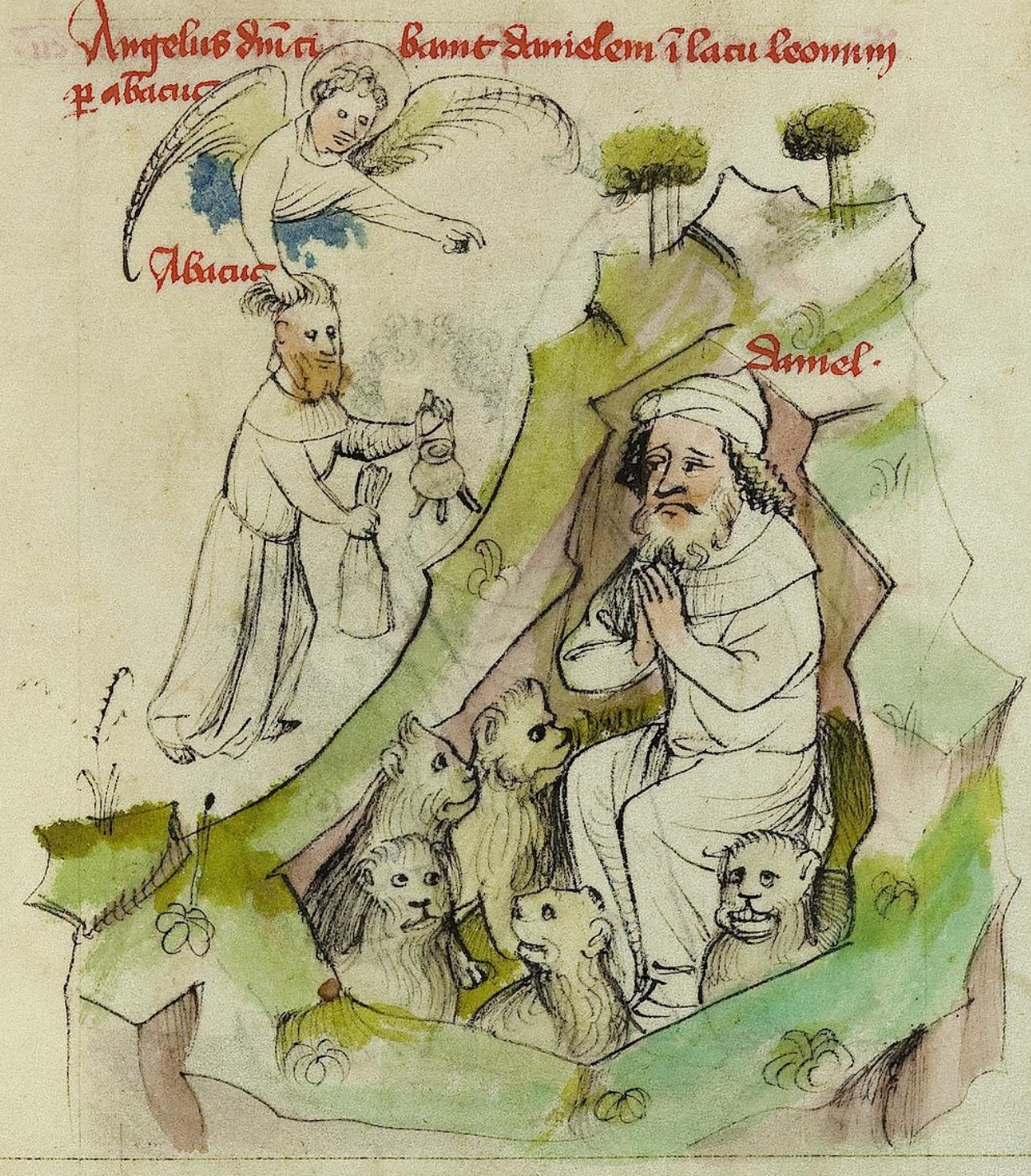
Chapter 28a: Daniel in the lion's den
To prove that his faith in the Jewish God is well-founded, Daniel is thown into a pit with several ferocious lions, but remains unharmed because he is protected by an angel.
Speculum
- This was also foreshadowed by Daniel in the lions' den,
- To whom the Lord sent a meal through Habakkuk.
- Daniel had been sent into the lions' den by the Babylonians,
- To be consumed by seven hungry lions;
- But the Lord kept him unharmed by the lions
- And sent him a meal by his angel:
- So God defended the fathers in limbo for a long time from demons,
- And at length he himself came and fed them with divine meals.
- The lake of Babylon designates the world,
- And the seven lions are the number of all demons:
- The number of demons is usually described by seven demons,
- Because demons attack men by seven mortal sins:
- The names of these mortal sins are: pride and envy,
- Anger and sloth, avarice, gluttony and lust;
- These are the weapons of demons and diabolical weapons,
- With which they lie in wait for men and fortify the infernal camps.
Christian Bible, Daniel 6:16-23 (NIV)
So the king gave the order, and they brought Daniel and threw him into the lions’ den. The king said to Daniel, "May your God, whom you serve continually, rescue you." A stone was brought and placed over the mouth of the den, and the king sealed it with his own signet ring and with the rings of his nobles, so that Daniel’s situation might not be changed. Then the king returned to his palace and spent the night without eating and without any entertainment being brought to him. And he could not sleep. At the first light of dawn, the king got up and hurried to the lions’ den. When he came near the den, he called to Daniel in an anguished voice, "Daniel, servant of the living God, has your God, whom you serve continually, been able to rescue you from the lions?" Daniel answered, "May the king live forever! My God sent his angel, and he shut the mouths of the lions. They have not hurt me, because I was found innocent in his sight. Nor have I ever done any wrong before you, Your Majesty." The king was overjoyed and gave orders to lift Daniel out of the den. And when Daniel was lifted from the den, no wound was found on him, because he had trusted in his God.
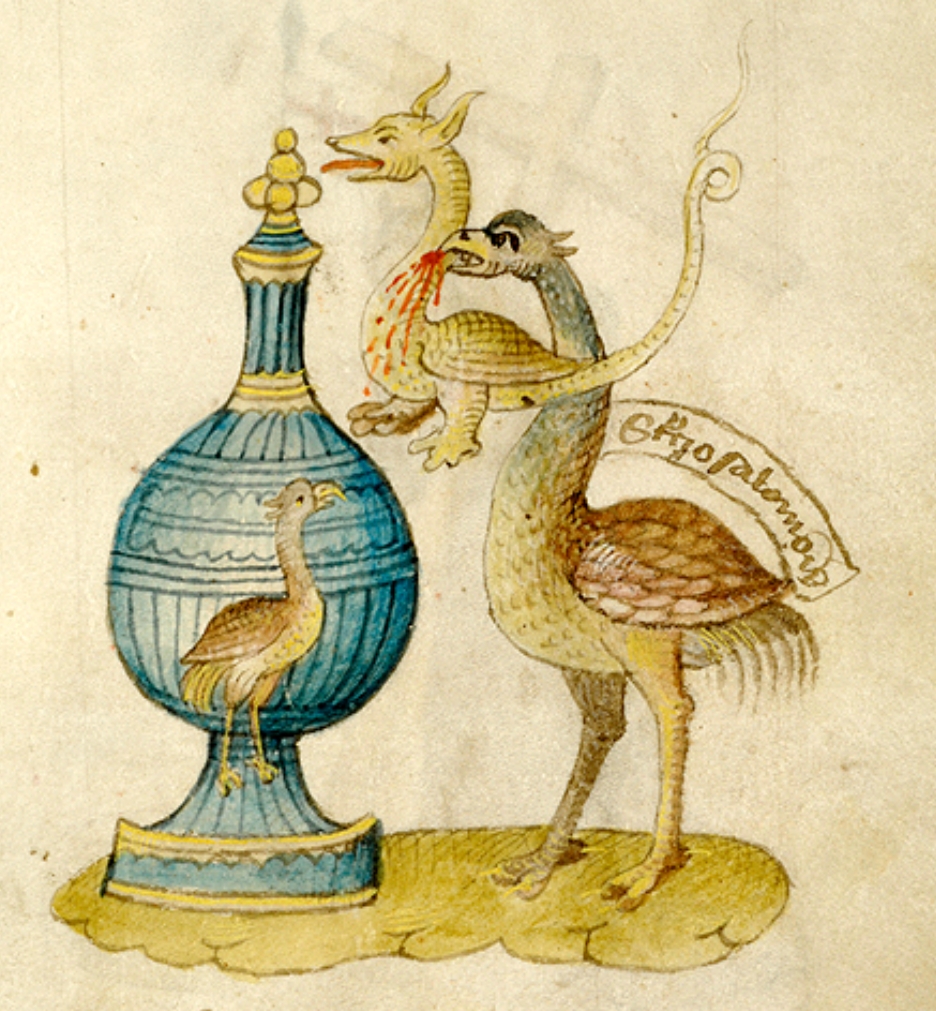
Chapter 28b: Ostrich freeing its chick with the aid of a thamur worm
In the Babylonian Talmud, Tractate Gittin is a story of how Solomon used a shamir worm to break the stone used in building the temple in Jerusalem, without having to use iron tools. This story changed over time, until in the middle ages it became the story of the ostrich and the thamur worm found in the Speculum.
For more on this legend, see the encylopedia article on The Ostrich and the Thamur.
Speculum
- And although hell was fortified with many weapons and demons,
- But Christ easily broke it with his blood.
- This had once been foreshadowed in Solomon's ostrich,
- Whose chick King Solomon enclosed in a glass vessel;
- The ostrich, desiring to free its chick from confinement,
- Went into the desert and brought from there a certain worm,
- Which, compressed, squeezed out blood upon the glass,
- And at the touch of it the glass split in half:
- Thus when the blood of Christ was shed on the cross,
- Hell was broken as glass, and man went forth free.
Babylonian Talmud, Tractate Gittin, 68a
As it is written with regard to the building of the Temple: "For the house, when it was being built, was built of stone made ready at the quarry; and there was neither hammer nor axe nor any tool of iron heard in the house, while it was being built" (I Kings 6:7). Solomon said to the sages: How shall I make it so that the stone will be precisely cut without using iron? They said to him: There is a creature called a shamir that can cut the stones, which Moses brought and used to cut the stones of the ephod. ... [The demon] Ashmedai said to [Solomon]: The shamir was not given to me, but it was given to the angelic minister of the sea. And he gives it only to the wild rooster, also known as the dukhifat or the hoopoe, whom he trusts by the force of his oath to return it. ... They investigated and found the nest of a wild rooster in which there were chicks, and he covered its nest with translucent glass. When the rooster came it wanted to enter the nest but was unable to do so. It went and brought the shamir and placed it on top to crack the glass. Solomon’s servant threw a clump of dirt at the rooster and the rooster knocked over the shamir. The man took it and the wild rooster went and strangled itself over the fact that it had not kept its oath, by not returning the shamir. - [From the Sefaria Library]
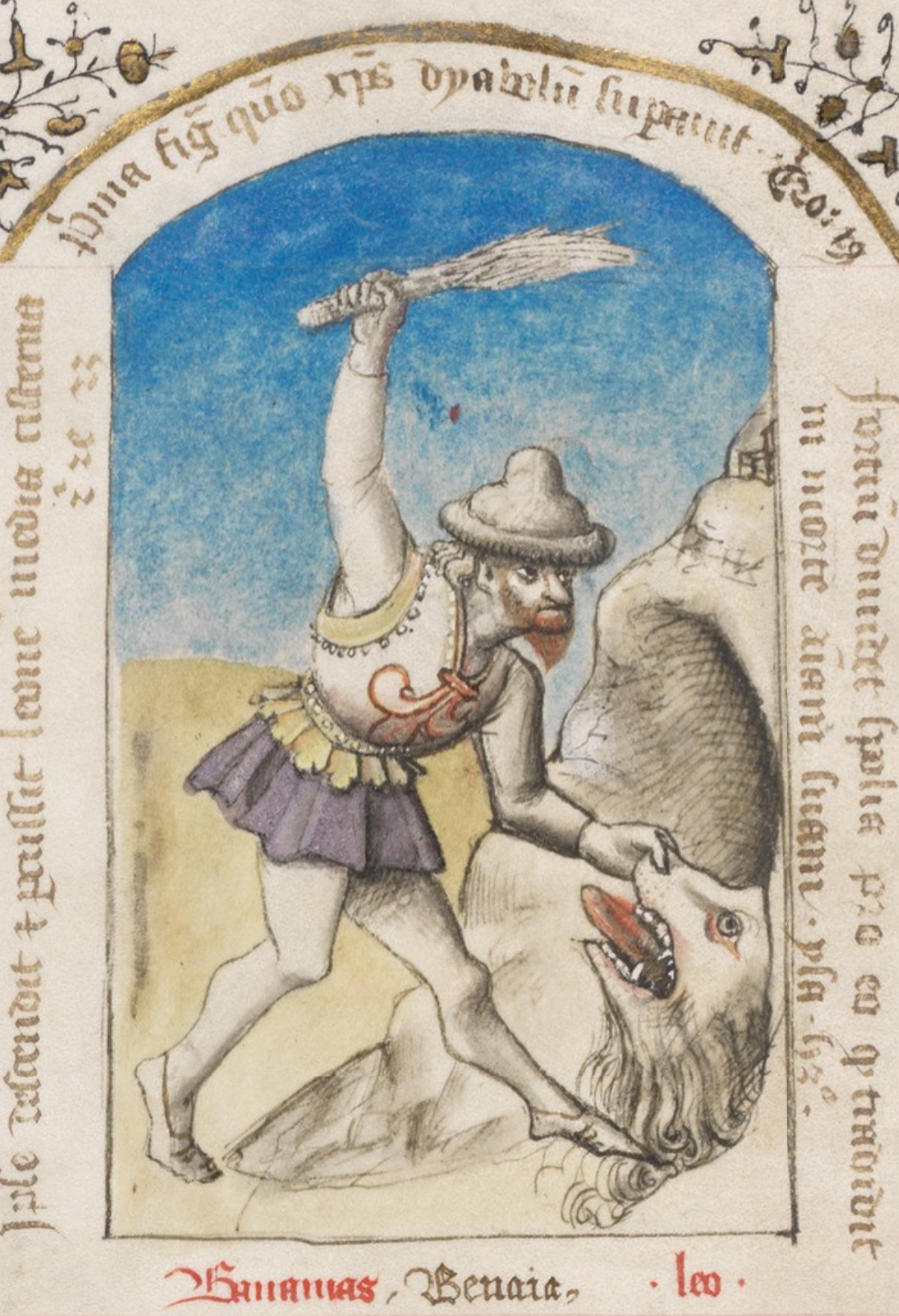
Chapter 29a: Benaiah kills a lion in a cave
Benaiah (or Banaias) was one of king David's warriors. One of his feats of bravery was to kill a lion in a cave or pit, prefiguring Christ's decent into hell.
Speculum
- This was once foreshadowed by Banaias,
- Who, coming to the lion in the pit, with his rod, prostrated him:
- So Christ entered the pit to the devil, that is, into hell,
- And by rod and staff, that is, by the holy cross, prostrated him;
- And this is what the words of the prophet once intended in the psalm:
- "Your rod and your staff have comforted me."
- Rod in this place is taken for the staff, which a man carries in his hand when walking,
- That by it he may be supported and defend himself from dogs.
- Therefore the cross of Christ is the staff by which we are supported, lest we fall,
- By which we also drive away the dogs of hell from us;
- By this staff Christ prostrated the infernal lion
- And he gave us the same staff to resist the devil.
Christian Bible, 2 Samuel 23:20 (NIV)
Benaiah son of Jehoiada, a valiant fighter from Kabzeel, performed great exploits. He struck down Moab’s two mightiest warriors. He also went down into a pit on a snowy day and killed a lion.
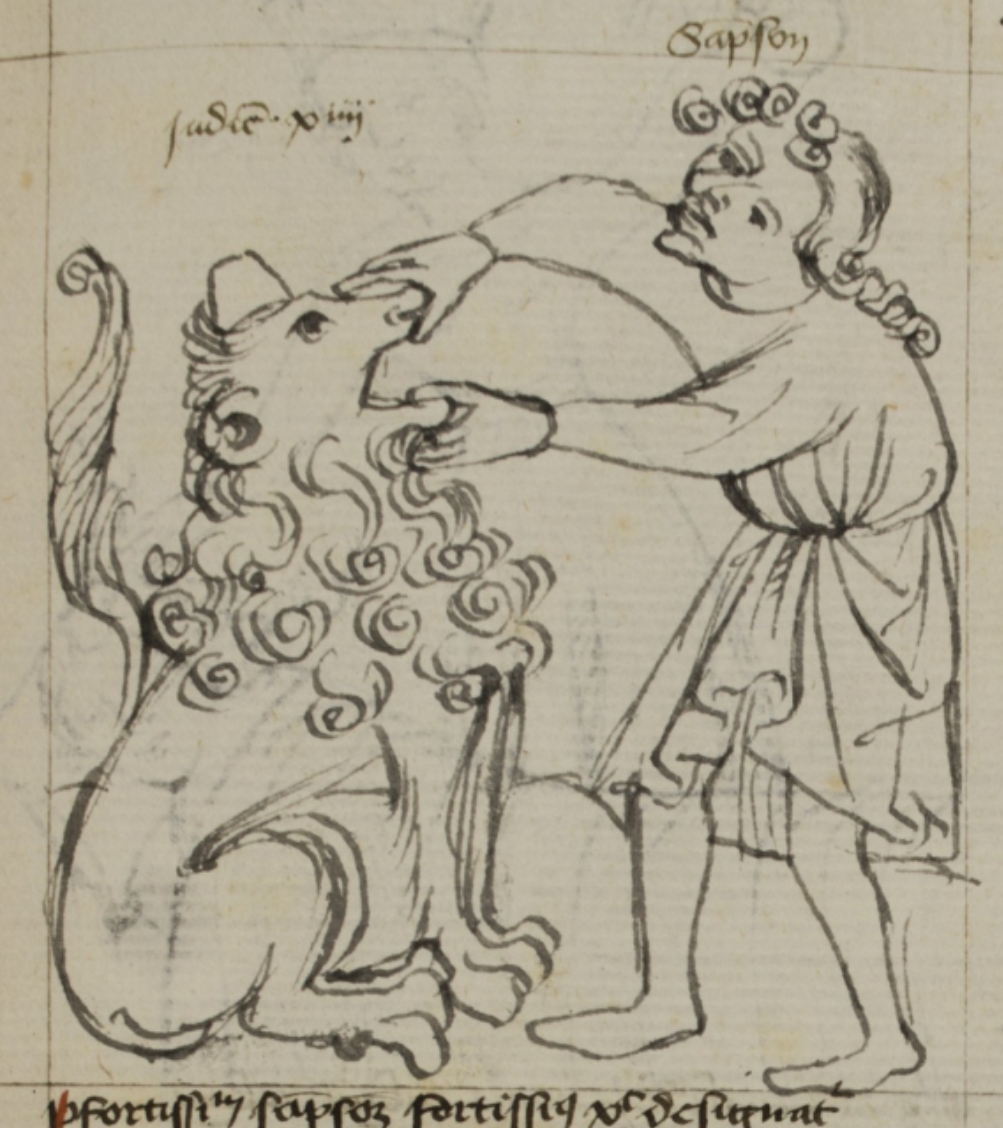
Chapter 29b: Samson kills a lion with his bare hands
When Samson was on a journey, a lion attacked him. Samson killed the lion, tearing it apart with his bare hands.
Speculum
- The victory of Christ was once foreshadowed by Samson,
- Who in the wilderness of Engedi tore the lion to pieces.
- By the most valiant Samson the most valiant Christ is designated,
- By whom the infernal lion, that is, the devil, was deprived of his power.
- Samson went to betroth himself a wife,
- And on the way he killed a lion that met him;
- Thus the Son of God descended from heaven into this world,
- That he might enter into marriage with human nature.
- Samson took a woman from Thamnath to wife;
- The Son of God chose for himself a Jewess among all nations.
- The Thamnath woman deceitfully defrauded Samson;
- Thus also the Jewess dealt treacherously with Christ.
- Samson burned the crops and vineyards of his enemies,
- And fighting against them, defended himself from all;
- Thus Christ finally avenged himself of the Jews,
- When he laid waste Judea by the Roman army.
- Samson therefore foreshadowed the most valiant Christ,
- Who overcame the infernal lion, our enemy.
Christian Bible, Judges 14:5-6 (NIV)
Samson went down to Timnah together with his father and mother. As they approached the vineyards of Timnah, suddenly a young lion came roaring toward him. The Spirit of the Lord came powerfully upon him so that he tore the lion apart with his bare hands as he might have torn a young goat. But he told neither his father nor his mother what he had done.
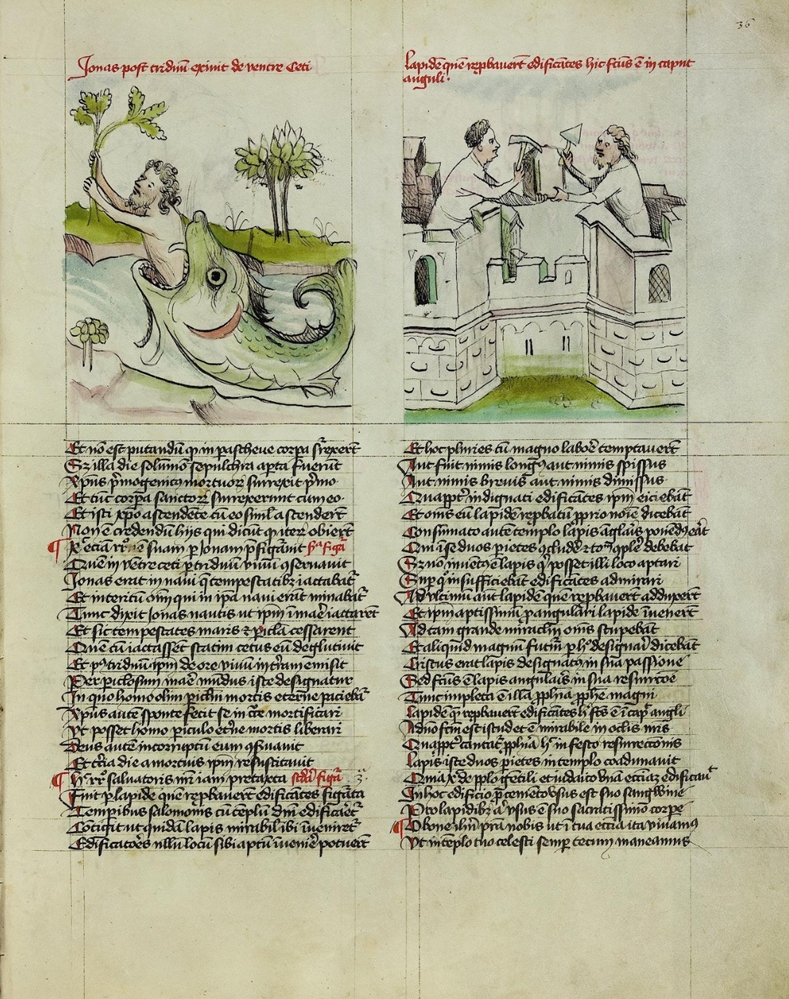
Chapter 32: Jonah escapes from the whale that had swallowed him
After three days in the belly of a whale (or "great fish"), Jonah prayed to God for help, and God caused the whale to vomit Jonah out onto the shore. This prefigured Christ rising from the dead after three days in his tomb.
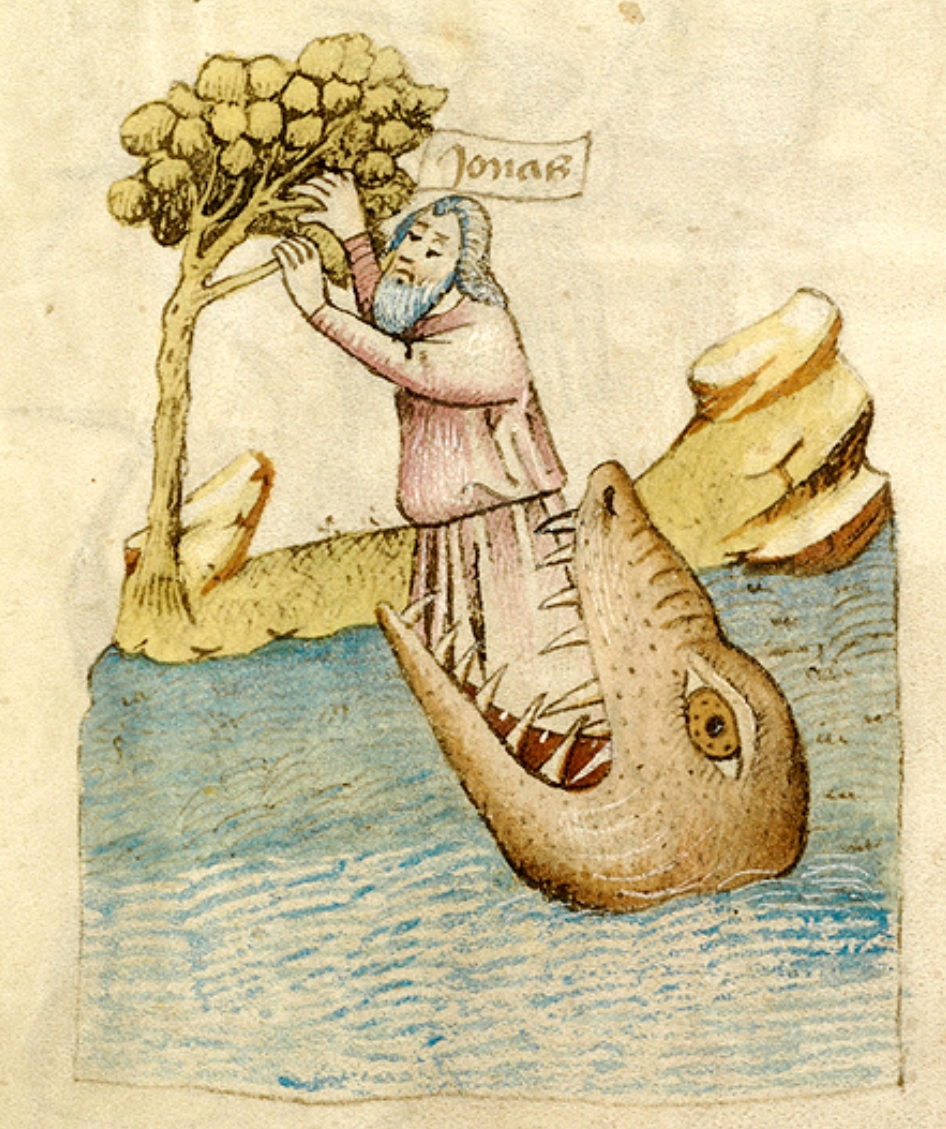
Speculum
- Christ also foreshadowed his resurrection through Jonah.
- Whom he preserved alive in the belly of a whale for three days.
- Jonah was on a ship that was tossed about by storms
- And threatened the destruction of all who were in it
- Then Jonah told the sailors to throw him into the sea,
- And thus the storms of the sea and the dangers would cease;
- And when they had thrown him, the whale immediately swallowed him
- And after three days he released him alive from his mouth onto the land.
- By the dangerous sea is designated this world,
- In which man suffered the danger of eternal death;
- But Christ voluntarily caused himself to be mortified on the cross,
- That man might be freed from the danger of eternal death.
- But God, having preserved him incorruptible,
- And on the third day raised him from the dead.
Christian Bible, Jonah 2:1 & 10 (NIV)
From inside the fish Jonah prayed to the Lord his God. ... And the Lord commanded the fish, and it vomited Jonah onto dry land.
Chapter 33: Man rescues one of his sheep that had been lost
In this parable, one of a few based on the Christian New Testament, a man leaves his sheep flock to search for and rescue a single lost sheep. In many of the illustrations, the man has a halo or is otherwise identified as Christ.
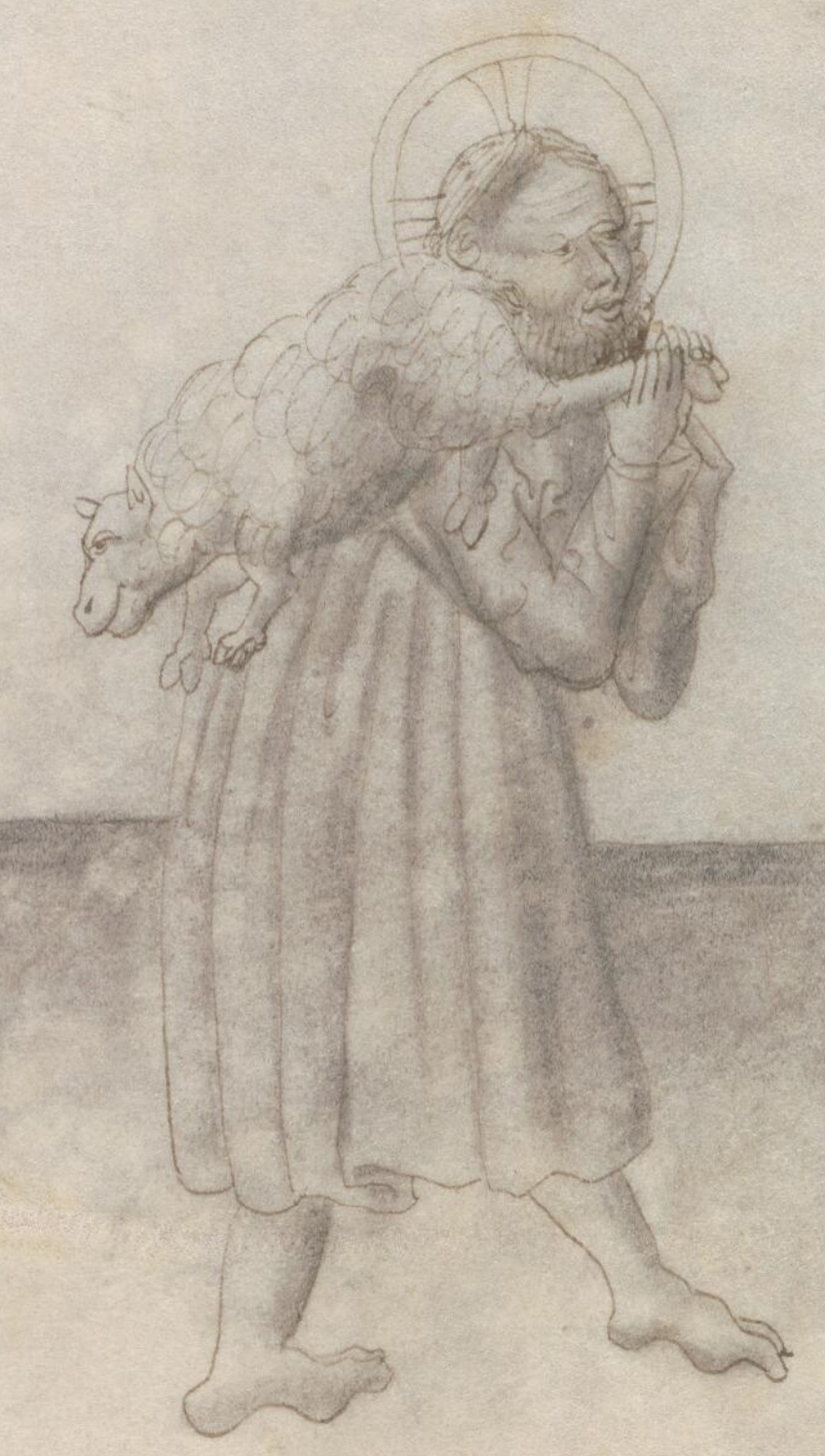
Speculum
- Christ also foretold this ascension into heaven,
- When he foretold the parable of the lost and found sheep:
- For he said of a certain man, who lost one of his sheep,
- And leaving the ninety-nine in the wilderness, he went to seek it;
- Which when he had found, he rejoiced greatly.
- And putting it on his shoulders, he carried it home to his house,
- And calling his friends, he told them of his joy
- And he earnestly urged them to rejoice with him.
- By this man God is designated,
- Because for our salvation he truly deigned to become man.
- A hundred sheep make one and ninety-nine:
- By this we must understand nine choirs of angels and a man.
- Of these one sheep was lost and perished,
- When man, having transgressed the commandment of God, perished by eternal death.
- But God sent nine choirs of angels into the wilderness,
- And coming into this world, he sought the lost man;
- For thirty-three years he sought and toiled so much
- That bloody sweat emanated from his whole body.
- See, man, how much he longed to find you,
- Who sought you with so much labor and for so long a time.
- And the sheep he found he placed upon his shoulders and carried,
- When he bore the cross for our dead on his own shoulders.
Christian Bible, Luke 15:3-7 (NIV)
Then Jesus told them this parable: "Suppose one of you has a hundred sheep and loses one of them. Doesn't he leave the ninety-nine in the open country and go after the lost sheep until he finds it? And when he finds it, he joyfully puts it on his shoulders and goes home. Then he calls his friends and neighbors together and says, 'Rejoice with me; I have found my lost sheep.' I tell you that in the same way there will be more rejoicing in heaven over one sinner who repents than over ninety-nine righteous persons who do not need to repent."
